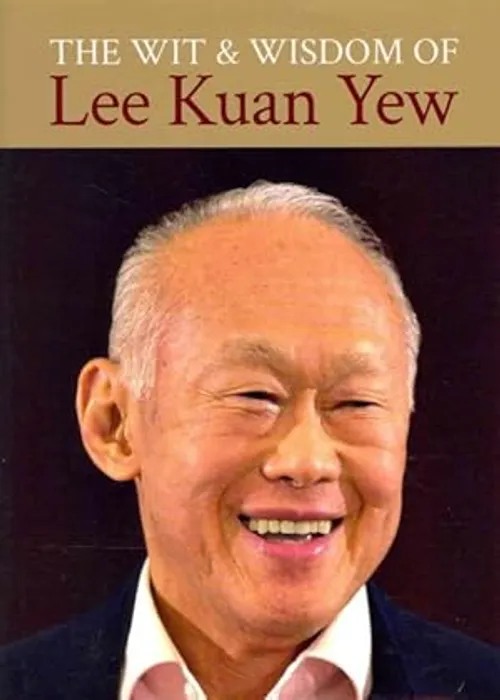
Lee Kuan Yew played the pivotal role in Singapore’s transition from British Crown Colony to independent developing nation, and on to the economically powerful and diplomatically influential city-state it is today. Throughout this surprising and at times painful journey, he has proved a charismatic and occasionally controversial leader.
The weakness of democracy is that the assumption that all men are equal and capable of equal contribution to the common good is flawed.
Contrary to what American political commentators say, I do not believe that democracy necessarily leads to development. I believe that what a country needs to develop is discipline more than democracy. The exuberance of democracy leads to undisciplined and disorderly conditions which are inimical to development. The ultimate test of the value of a political system is whether it helps that society to establish conditions which improve the standard of living for the majority of its people plus enabling the maximum of personal freedoms compatible with the freedoms of others in society.
There are some flaws in the assumptions made for democracy. It is assumed that all men and women are equal or should be equal. Hence, one man, one vote. But is equality realistic? If it is not, to insist on equality must lead to regression. Let me put it to the test in some theoretical situations. If we had a world government for this small interdependent world, will one man, one vote lead to progress or regression? All can immediately see that the developed and educated peoples of the world will be swamped by the undeveloped and the uneducated, and that no progress will be possible.
Americans are in a political malaise. Their academics and commentators know and publicly discuss their problems. But there is no political will in either the Republican or Democratic party to get American voters to face the facts of life, namely that they are living beyond their means and that to regain competitiveness, they must cut spending, especially on welfare, increase savings and investments, improve education, and improve work attitudes, before consumption can be allowed to go up again.
We have used to advantage what Britain left behind: the English language, the legal system, parliamentary government and impartial administration. However, we have studiously avoided the practices of the welfare state. We saw how a great people reduced themselves to mediocrity by levelling down. The less enterprising and less hardworking cannot be made equal simply by cutting down the achievements of the enterprising and the striving. And we have seen how difficult it is to dismantle a system of subsidised living once people get accustomed to a government providing for them.
More can and will be done for the elderly, the young and the needy, provided we can find the men and women to give their time. The government will provide the buildings and facilities. What the government cannot provide is the personal touch and the direct contact of voluntary social workers. Their altruistic and charitable feelings can motivate people to help themselves. Many welfare schemes in the West become bureaucratic and wasteful, because paid officials do not have those feelings and sentiments of altruism and idealism which volunteer social workers have. Hence paid officials cannot generate reciprocal feelings of appreciation and gratitude from those they help. It is this crucial factor of high morale, both in the giver and in the receiver, that makes the difference between the communitarian way of welfare which is effective, as against official or bureaucratic welfare which demotivates those receiving handouts.
I think the Americans seem to be willing to spend now and to mortgage the future, whereas no society in East Asia is mortgaging its future and letting their children pay for it. They are saving up to give their children a better
start.

When a nation breaks with the wisdom of its past traditions, it begins to die. The fact that it doesn’t die immediately seems to confuse a lot of educated and credentialed retards into believing that their new assumptions are viable when the truth is that there is a significant amount of inertia in a society that takes time to peter out before the full effects of the new course become apparent to everyone. — They Were Not Good For The Economy by Vox Day
I got started doing my month end household core yesterday maybe finish them today. Tomorrow I need to add some fresh water, dump holding tanks and get unhooked from city water. The water hose needs to be coiled up after it has warmed up, can’t do it when it is cold in the morning. Leaving here Monday morning, will write about the move next week.
I am predicting there will be some serious financial action in 2026. Read this article Pepe Escobar: How the BRICS+ Unit Project Can Dethrone the Dollar to see what is going on, the Main Stream Media in the United States will not be reporting on it. The Unit is to be launched early next year, stay tuned!
The Unit is defined as a resilient reserve of value, backed by a structure of 60% gold and 40% diversified BRICS+ currencies, providing stability and protection against inflation in the current global financial landscape of wobbly macroeconomics and widespread uncertainty. It is designed to serve as a convenient and stable global currency alternative within the existing financial infrastructure, offering long-term purchasing power stability and resilience to political interference. The Unit is neither a cryptocurrency nor a stablecoin, but rather a benchmark token or index token with intrinsic value anchored in real assets. Its integrity is preserved through a decentralized minting process based on a reserve basket of gold and BRICS+ currencies, ensuring that new tokens are issued in exchange for corresponding assets, maintaining the value parity across the system.