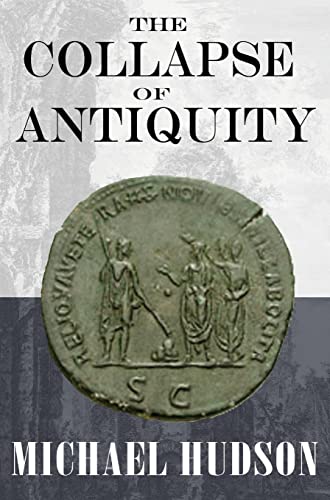
The Collapse of Antiquity, the sequel to Michael’s …and forgive them their debts is the second and latest book in his trilogy on the history of debt. It describes how the dynamics of interest-bearing debt led to the rise of rentier oligarchies in classical Greece and Rome, causing economic polarization, widespread austerity, revolts, wars and ultimately the collapse of Rome into serfdom and feudalism.
In telling this story,The Collapse of Antiquity reveals the eerie parallels between the collapsing Roman world and today’s debt-burdened Western economies. — Book promo @ Amazon
Rome never did solve its debt problem, leaving the Empire to suffer the momentum of economic polarization inherited from the Republic. Today’s West likewise has not succeeded in coping with debt in a way that saves its economies from polarizing. That similarity and the reason for it—the West’s inheritance of Rome’s pro-creditor legal philosophy—is the main relevance of Roman history for today’s world.

Poet, novelist, and farmer Berry restates his love for the land in these sonorous essays. The title piece, his 2012 Jefferson Lecture, posits that an abiding affection for place, such as his family’s deep ties to rural Kentucky, is essential for “a neighborly, kindly and conserving economy.” Elsewhere, he explores his adventures in civil disobedience, Kentuckians’ fraught relationship with their landscape, the coal industry’s assault on Appalachia, and the horse-drawn agriculture of the Amish.

We did not get a lot of rain, 0.92″, during the 48 hours starting around mid-morning on Saturday but it was raining off and on for that entire period. A lot of standing water all around Desperado yesterday morning. No walks during that entire time. Got out there this morning and did a walk while avoiding the soft mud the best that I could.
This is not to say politics has no influence on society at all. But that influence is limited, indirect, controlled, and inevitably bows before material force and spiritual power. Moreover, there is virtually no link between the will of the people as theoretically represented by their democratically-elected “representatives” and what the people of the nation actually want. Very few, if any, of the institutions and policies of the current US federal government were ever desired by the American people, and yet they were forced upon them anyhow. The same is true of most European nations.
I very much doubt that most of my readers, much less any of my critics, can fathom how low my expectations are. We swim in a sea of willfully delusional retardery and none of the things that obsess most political activists matter in the least; forget who will win the electoral race in the 4th California congressional district or whatever as most people across the West will consider themselves fortunate if they preserve electricity, clean water, and indoor plumbing in their neighborhoods and avoid being roasted over open fires. All polities collapse in time, and the USA is observably approaching the end of its viability as a unitary governing entity. I’m not the first to see this; Wang Hunin observed the same thing years before I predicted a collapse in the 2033 timeframe in 2004. — Vox Day