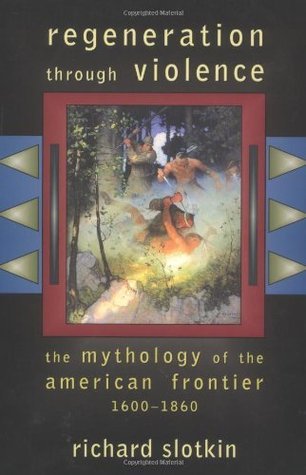
In Regeneration Through Violence , the first of his trilogy on the mythology of the American West, Richard Slotkin shows how the attitudes and traditions that shape American culture evolved from the social and psychological anxieties of European settlers struggling in a strange new world to claim the land and displace the Native Americans. Using the popular literature of the seventeenth, eighteenth, and early nineteenth centuries-including captivity narratives, the Daniel Boone tales, and the writings of Hawthorne, Thoreau, and Melville-Slotkin traces the full development of this myth. — Book promo @ goodreads.com
Although the captivity myth remained potent, the publieation of Church’s Entertaining Passages in 1716 marks a turning point in the literary mythology of the Indian wars. Church substituted a realistic acceptance of the conditions of moral and physical life imposed by the wilderness for the Puritan rejection of the wilderness as a chaotic and devilish environment. Further, in the course of imaginatively reconstructing his adventures, he unconsciously employed a myth-archetype which differed considerably from that most often employed by the Puritans. He substituted the ritual of initiation for that of exorcism and the figure of a hunter-hero for that of a god- and devil-bullied victim. Although negative interpretations of the wilderness persisted—and the distrust of emigration and frontiersmen did remain a persistent strain in New England (and later in the United States)—the books which followed Church’s tended to treat the landscape of the wilderness with more realism, denying neither its harshness nor its beauty. Their authors aimed more at increasing the colonists’ sense of security, of at-homeness in the wilderness, than at compelling them to reject the New World and cling to the remembered old. Between 1716 and 1784, from the appearance of Church’s book to that of Filson’s Discovery, Settlement and Present State of Kentucke, the Puritan vision of the New World underwent a drastic change, shifting its basis from the captivity myth and the Westminster Confession to a more secularized world view, based on rationalistic philosophy and continuing experience on the frontier.
True myth concerns itself centrally with the onward adventure of the integral soul. And this, for America, is Deerslayer. A man who turns his back on white society…. An isolate, almost selfless, stoic, enduring man, who lives by death, by killing, but who is pure white.
You have there the myth of the essential white America. All the other stuff, the love, the democracy, the floundering into lust, is a sort of by-play. The essential American soul is hard, isolate, stoic, and a killer. It has never yet melted. — D. H. Lawrence, Studies in Classic American Literature
We have, I think, continued to associate democracy and progress with perpetual social mobility (both horizontal and vertical) and with the continual expansion of our power into new fields or new levels of exploitation. Under the aspect of this myth, our economic, social, and spiritual life is taken to be a series of initiations, of stages in a movement outward and upward toward some transcendent goal.

Nothing much going on. There was cloud cover this morning which made for very cool walk although the morning temperatures have been very nice. The daily highs are more than I want to be out walking but the morning are great. Just doing a lot of reading and trying to stay cool during most of the day after finishing our walk. I’ll go to town again on Monday for my regular shopping, maybe pick up a package at the post office and stop at the garage for them to check Desperado for any water leaks.