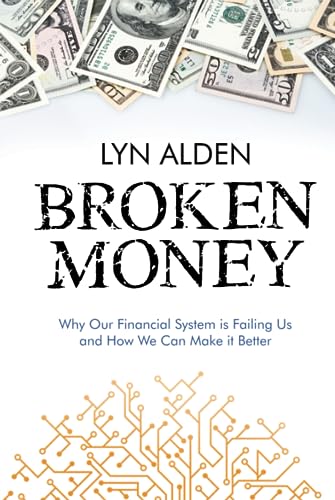
Broken Money explores the history of money through the lens of technology. Politics can affect things temporarily and locally, but technology is what drives things forward globally and permanently. The book’s goal is for the reader to walk away with a deep understanding of money and monetary history, both in terms of theoretical foundations and in terms of practical implications.
From shells to gold, from papyrus bills of exchange to central banks, and from the invention of the telegraph to the creation of Bitcoin, Lyn Alden walks the reader through the emergence of new technologies that have shaped what we use as money over the ages. And beyond that, Alden explores the concept of what money is at its very foundation to give the reader a framework to analyze and compare different types of monetary technologies and monetary theories.
The book also takes a distinctively human look at how money impacts the lives of real people, and how new monetary technologies shape the power structures within society.
In the modern era, energy abundance and technological enhancements have broadly improved human well-being, but the global monetary system has been slow to keep up. There are over 160 active currencies in the world, each with a local monopoly over its own country, and with little or no acceptance elsewhere. Many of them are rapidly diluted, which continually devalues the savings and the wages of the billions of people who live and work within those jurisdictions. Being born in the “wrong” country makes saving money far harder than it needs to be.
Nigeria has a population of over 200 million people and has averaged 13% annualized inflation over the past decade. Egypt cut its currency in half relative to the dollar twice over the past decade, which instantly devalued the savings and wages of its 100 million citizens. Dozens of countries have experienced at least triple-digit year-over-year inflation within the past four decades, including Brazil that outright hyperinflated in the 1990s while it was the fifth most populous country in the world.
Europe and Japan had $18 trillion worth of negative-yielding bonds in 2019, right before a wave of inflation wiped their purchasing power away. In 2021, the chairman of the U.S. Federal Reserve dismissed the idea that the sharp rise in the money supply from the pandemic stimulus would lead to price inflation. By 2022, as major inflation emerged, the chairman rapidly changed his outlook and tightened monetary policy so quickly that it led to the failure of some of the largest banks in the country.
How did we get to this point? Why isn’t our money better than this in the 21st century? Broken Money answers these questions by examining the current mix of technology that has led to these limitations, and then explores emerging technologies that may be able to provide us with a monetary system that is fit for the modern era. — Book promo @ goodreads.com
Readers of this part of the book who have not previously been bullish or interested in Bitcoin may be thinking, “some of this is neat, but I don’t think it’ll work in the long run.” If that is your view, you’re in good company with the author. I think it’s a healthy and natural response to be skeptical of the long-term financial value of this technology.
We cannot know the future. The best that we can do is analyze the present, envision what we think the future should be like, and then play our individual roles to move toward that vision. In my view, open-source decentralized money that empowers individuals, that is permissionless to use, and that allows for a more borderless flow of value, is both powerful and ethical. The concept presents an improvement to the current financial system in many ways and provides a check on excessive power, which makes it worth exploring and supporting.

My long day of running around started with a stop at Sandy’s Restaurant in Sunizona where I got my usual veggie omelet which has always been good there. I continued the drive to the South Bisbee post office where I mailed a letter back to the VA in Tucson telling them that my provider at the VA Clinic in Sierra Vista was working on an appointment for the follow up CT scan in Nov ’27. Then just a few blocks from there I did a grocery gathering at Safeway.
I had a short wait then before walking to my dental appointment in Naco, MX. This was a brief appointment that just was to give me my new partial. It is a much match with the upper teeth that my previous partial. This one has the four lower front teeth plus the first lower molar in the right side. The partial when taken out looks rather strange but in gives me the ability to chew on the right side which was restricted a lot without that added tooth.
Then drove to Sierra Vista with a stop at the VA Clinic where I wanted to talk to the Team 2 nurse that is working on my appointment in Tucson. I wanted to find out what the situation was with that. I also wanted to see if she could get the bureaucratic gears moving that would let me use the VA Community Care Network at the hospital in Wilcox. I now meet the specific eligibility requirements with my location in the Park here. This might move the Nov ’27 CT appointment from VA Tucson which is my desire. I really don’t want to have any more to do with VA Tucson than I can avoid.
The last stop of the day was at WalMart Vision where I picked up my new glasses frame that had progressive lens rather than bifocal. As soon as I tried them on I knew that I had made the right change. I wore progressives for many years and after the cateract surgery I did not need distance vision correction so thought bifocals would work. Didn’t like them from the start and didn’t like them any better as time wore on.
The low yesterday morning was 28°F and I was glad to be in Desperado with the heater. This mornings low was 29 with it warming up to 30 or freezing while we were doing our walk. Maybe a couple more mornings like this and then if the weather guessers get it anywhere close to right it will be in the low 40s. Either way I say winter is here.