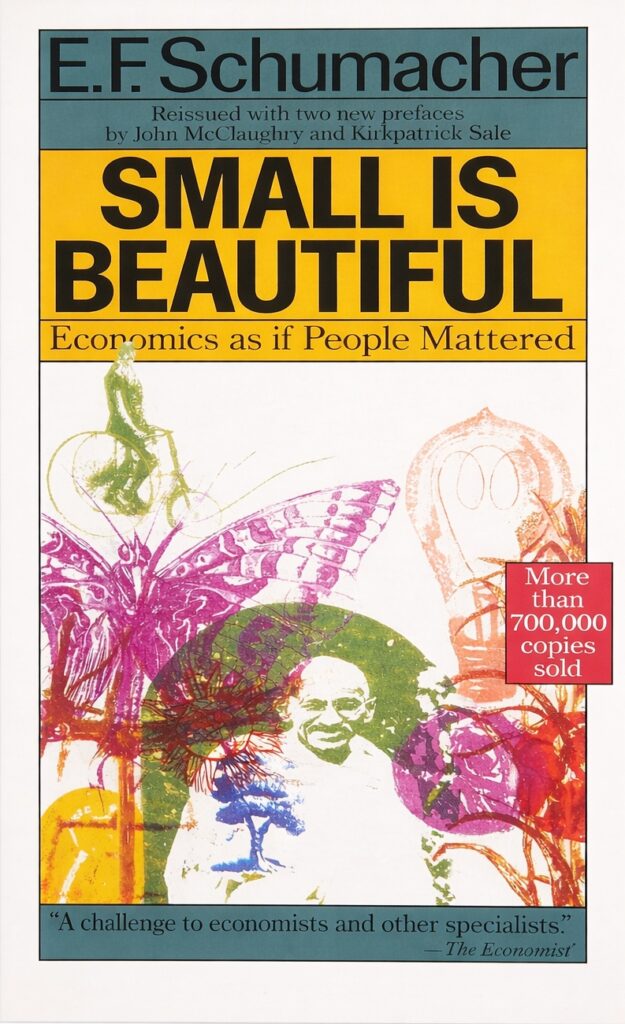
A consistent theme in positive reviews is the appreciation for Schumacher’s focus on people over goods. Reviewers resonate with the argument that economies should prioritize meaningful work and psychological stability over endless GDP growth. The concept of “intermediate technology”—tools that are efficient yet accessible to small communities—is frequently cited as a standout idea.
Reviewers often discuss Schumacher’s definition of wisdom as the ability to project permanence. The critique that modern economics treats irreplaceable natural capital (like fossil fuels) as income is widely praised as a fundamental truth that mainstream economics still ignores. This section of the book is often described as a “call to restraint” that contrasts sharply with consumerist culture.
The country has risen by, say, five per cent, the economist-turned-econometrician is unwilling, and generally unable, to face the question of whether this is to be taken as a good thing or a bad thing. He would lose all his certainties if he even entertained such a question: growth of GNP must be a good thing, irrespective of what has grown and who, if anyone, has benefited. The idea that there could be pathological growth, unhealthy growth, disruptive or destructive growth is to him a perverse idea which must not be allowed to surface.
The religion of economics promotes an idolatry of rapid change, unaffected by the elementary truism that a change which is not an unquestionable improvement is a doubtful blessing. The burden of proof is placed on those who take the “ecological viewpoint”: unless they can produce evidence of marked injury to man, the change will proceed. Common sense, on the contrary, would suggest that the burden of proof should lie on the man who wants to introduce a change; he has to demonstrate that there cannot be any damaging consequences. But this would take too much time, and would therefore be uneconomic. Ecology, indeed, ought to be a compulsory subject for all economists, whether professionals or laymen, as this might serve to restore at least a modicum of balance. For ecology holds “that an environmental setting developed over millions of years must be considered to have some merit. Anything so complicated as a planet, inhabited by more than a million and a half species of plants and animals, all of them living together in a more or less balanced equilibrium in which they continuously use and re-use the same molecules of the soil and air, cannot be improved by aimless and uninformed tinkering. All changes in a complex mechanism involve some risk and should be undertaken only after careful study of all the facts available. Changes should be made on a small scale first so as to provide a test before they are widely applied. When information is incomplete, changes should stay close to the natural processes which have in their favour the indisputable evidence of having supported life for a very long time”. — Basic Ecology by Ralph and Mildred Buchsbaum
In the excitement over the unfolding of his scientific and technical powers, modern man has built a system of production that ravishes nature and a type of society that mutilates man. If only there were more and more wealth, everything else, it is thought, would fall into place. Money is considered to be all-powerful; if it could not actually buy non-material values, such as justice, harmony, beauty or even health, it could circumvent the need for them or compensate for their loss. The development of production and the acquisition of wealth have thus become the highest goals of the modern world in relation to which all other goals, no matter how much lip-service may still be paid to them, have come to take second place.

The afternoon rains have continued which has kept the daily high temperature down but has raised the humidity a lot. The morning walks are still being done in very pleasant temperatures but I’m sweating more than when the temperatures were higher. Maybe not sweating more but it just does not evaporate.