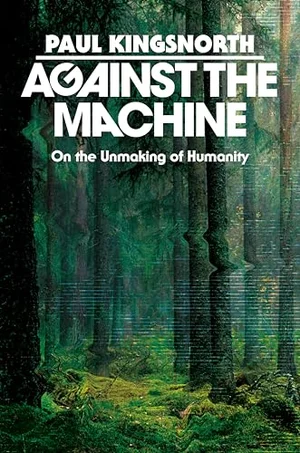
An extended neo-Thoreauvian polemic against a culture of despoliation, consumerism, and urbanism.
The world, writes English novelist and environmentalist Kingsnorth, is dominated by “a metastasizing machine which is closing in around you, polluting your skies and your woods and your past and your imagination,” the world of nature increasingly replaced by “a left-brain paradise, all straight lines and concrete car parks.” One aspect of this destructive machine, by his account, is the steady decline of religion—not in itself necessarily a bad thing, but, given that nature abhors a vacuum, “when a culture built around such a sacred order dies then there will be upheaval at every level of society,” and given the absence of that sacred order, the door is wide open to its replacement by things other than the two that we need, “meaning, and roots.” By Kingsnorth’s lights, the origin of so much of the world’s current crisis is an “ongoing process of mass uprooting,” not just from one’s native place (as with China’s relocation of Tibetans and Uyghurs) but also our cultural uprooting from our traditions and our divorce from nature. Kingsnorth often paints with a brush that may be a few hairs too wide: He condemns science, for instance, as “an ideology posing as a method,” when science is likely the only thing that might rescue the world from the worst consequences of climate change, and his insistent view of cities as doomed and soulless places devoted only to profit too often slides into cant. Still, a little fire and brimstone never hurts an argument against things as they are, and if decrying the “the holy effort to which all human will, skill and energy is now bent: making money” gets a little shrill, his closing invocation of a culture in which “people, place, prayer, the past” are rediscovered resounds nicely. A spirited—sometimes too spirited—critique of the empty suit that is late capitalism and its trappings. — Kirkus Review
I think now that ‘the West’ is, above all, a way of seeing—a way of looking out at the world. Once, that gaze was Christian, but it has not been that way for a long time now. The contemporary Western gaze is the gaze of the Machine; of Enlightenment Man, of cosmopolis, of reason, of money. And it is because this gaze has been unable for centuries to appreciate that world in its fullness that we have come so unstuck. If we are going to get stuck again, as it were, we will need to learn to see the world very differently.
But Man cannot live by immanence alone. Religion meets a human need, and when it is gone, or corrupted, the hole it leaves will have to be filled by something else. What will that be? Del Noce’s answer is: revolution.
Modernity, he suggests, could be defined as a permanent, ongoing revolution. The desire to build Utopia on the bones of the old world has been the consuming fire of Western thought for 300 years. Jacobins, Bolsheviks, communists, socialists, Fascists, Nazis and many more have all attempted to scour the ground clean and start again, and we are not done yet. ‘The revolutionary attitude of creative violence’, writes Del Noce, ‘has replaced the ascetic attitude of seeking liberation from the world.’[9] If once society’s refuseniks imitated St Anthony, now they copy Che Guevara. ‘All that is solid melts into air’: this, in the words of its most consequential revolutionary mind, is the best description of the age of immanence that we have ever had.
We in the West invented this thing called ‘modernity’, and then we took it out into the world, whether the world wanted it or not. Once, we called this process ‘the white man’s burden’ and exported it with dreadnoughts. Now we call it ‘development’ and export it via the World Bank. But—and here is the point so often missed, especially by critics on the left—before we could eat the world, we first had to eat ourselves. Or rather: our states, our elites, our ideologues and power-mongers had to dispossess their own people before they could venture out to dispossess others. We were the prototype, the guinea pigs in a giant global experiment. Now we find ourselves rootless, rudderless, unmoored in a great sea of chaos; angry, confused, shouting at the world and each other. We have made of our world a nihil. We are both perpetrators and victims of a Great Unsettling.
To be GOVERNED is to be watched, inspected, spied upon, directed, law-driven, numbered, regulated, enrolled, indoctrinated, preached at, controlled, checked, estimated, valued, censured, commanded, by creatures who have neither the right nor the wisdom nor the virtue to do so. To be GOVERNED is to be at every operation, at every transaction noted, registered, counted, taxed, stamped, measured, numbered, assessed, licensed, authorized, admonished,prevented, forbidden, reformed, corrected, punished. It is, under pretext of public utility, and in the name of the general interest, to be place[d] under contribution, drilled, fleeced, exploited, monopolized, extorted from, squeezed, hoaxed, robbed; then, at the slightest resistance, the first word of complaint, to be repressed, fined, vilified, harassed, hunted down, abused, clubbed, disarmed, bound, choked, imprisoned, judged, condemned, shot, deported, sacrificed, sold, betrayed; and to crown all, mocked, ridiculed, derided, outraged, dishonoured. That is government; that is its justice;that is its morality. — Pierre Proudhon