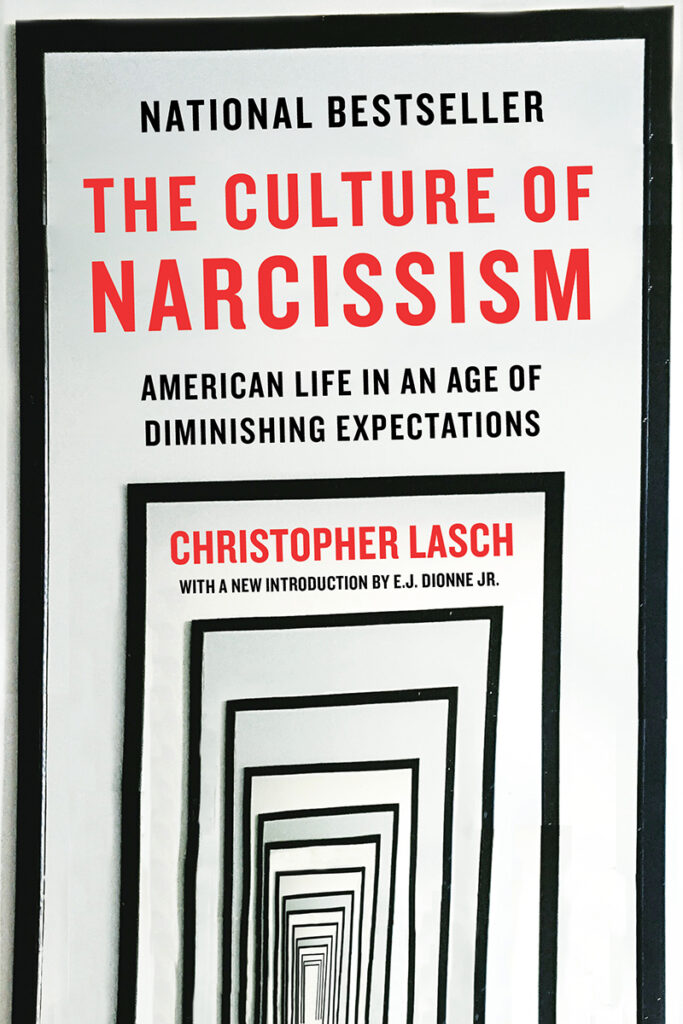
The Culture of Narcissism is a critical examination of American society, particularly during the late 1970s, authored by Christopher Lasch. The book posits that the American character was shifting from an individualistic mindset, which once emphasized personal achievement and societal contribution, to a more self-absorbed and narcissistic personality. Lasch identifies key traits of this new narcissistic individual, including a heavy reliance on external validation, emotional dependence on expert advice, and an inability to confront personal or societal issues independently. He argues that this shift resulted in a pervasive sense of unease and emptiness, as individuals became increasingly disconnected from their own moral authority and reliant on bureaucratic solutions to personal problems.
This first quote is from a book that was published in 1979. Nothing having changed, other than it has perhaps become worse, it could have been published last week!
In some ways middle-class society has become a pale copy of the black ghetto, as the appropriation of its language would lead us to believe. We do not need to minimize the poverty of the ghetto or the suffering inflicted by whites on blacks in order to see that the increasingly dangerous and unpredictable conditions of middle-class have given rise to similar strategies for survival. Indeed the attraction of black culture for disaffected whites suggests that black culture now speaks to a general condition, the most important feature of which is a widespread loss of confidence in the future. The poor have always had to live for the present, but now a desperate concern for personal survival, sometimes disguised as hedonism, engulfs the middle class as well. To-day almost everyone lives in a dangerous world from which there is little escape. International terrorism and blackmail, bombings, and hijackings arbitrarily affect the rich and poor alike. Crime, violence, and gang wars make cities unsafe and threaten to spread to the suburbs. Racial violence on the streets and in the schools creates an atmosphere of chronic tension and threatens to erupt at any time into full-scale racial conflict. Unemployment spreads from the poor to the white-collar class, while inflation eats away the savings of those who hoped to retire in comfort. Much of what is euphemistically known as the middle class, merely because it dresses up to go to work, is now reduced to proletarian conditions of existence. Many white-collar jobs require no more skill and pay even less than blue-collar jobs, conferring little status or security. The propaganda of death and destruction, emanating ceaselessly from the mass media, adds to the prevailing atmosphere of insecurity. Far-flung famines, earthquakes in remote regions, distant wars and uprisings attract the same attention as events closer to home. The impression of arbitrariness in the reporting of disaster reinforces the arbitrary quality of experience itself,
and the absence of continuity in the coverage of events, as today’s crisis yields to a new and unrelated crisis tomorrow, adds to the sense of historical discontinuity—the sense of living in a world in which the past holds out no guidance to the present and the future has become completely unpredictable.
In some ways the most characteristic expression of the times is the campaign against old age, which holds a special terror for people today. As the proportion of old people in the population increases, the problem of old age attracts the anxious attention of doctors, demographers, psychiatrists, medical researchers, sociologists, social reformers, policy makers, and futurologists. A growing number of sciences and pseudosciences concern themselves specifically with aging and death: geriatrics, gerontology, thanatology, cryonics, “immortalism/’ Many others, notably genetics, genetic- engineering, and commimity medicine, have enlisted in the struggle to alleviate or abolish the ravages of tune -a struggle dear to the heart of a dying culture.
Two approaches to the problem of age have emerged. The first seeks not to prolong life but to improve its quality, especially the quality of what used to be known as the declining years. Resisting the equation of old age with loss of powers, proponents of this approach demand a more active social role for those who, though past middle age, have by no means outlived their usefulness. Humanitarians insist that old age is a social category, not a biological one. The modern problem of old age, from this point of view, originates less in physical decline than in society’s intolerance of old people, its refusal to make use of their accumulated wisdom, and its attempt to relegate them to the margins of social existence.
The second approach proposes to deal with old age as a medical problem, in Albert Rosenfeld’s words “something your doctor may some day hope to do something about.”
Falsely attributing to modem medicine an increase in life expectancy that actually derives from a higher standard of living, it assumes that medicine has the power to lengthen life still further and to abolish the horrors of old age. By the year 2025, Rosenfeld believes, “most of the major mysteries of the aging process will have been solved.”
Ostensibly egalitarian and antiauthoritarian, American capitalism has rejected priestly and monarchical hegemony only to replace it with the hegemony of the business corporation, the managerial and professional classes who operate the corporate system, and the corporate state. A new ruling class of administrators, bureaucrats, technicians, and experts has appeared, which retains so few of the attributes formerly associated with a ruling class—”pride of place, the Tiabit of command,” disdain for the lower orders—that its existence as a class often goes unnoticed. The difference between the new managerial elite and the old propertied elite defines the difference between a bourgeois culture that now survives only on the margins of industrial society and the new therapeutic culture of narcissism.