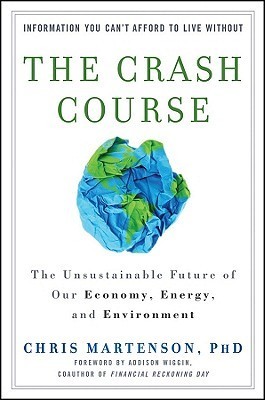
The next twenty years will be completely unlike the last twenty years. The world is in economic crisis, and there are no easy fixes to our predicament. Unsustainable trends in the economy, energy, and the environment have finally caught up with us and are converging on a very narrow window of time—the “Twenty-Teens.” The Crash Course presents our predicament and illuminates the path ahead, so you can face the coming disruptions and thrive—without fearing the future or retreating into denial. In this book you will find solid facts and grounded reasoning presented in a calm, positive, non-partisan manner.
There’s very little difference between Walmart and an industrial farm. Both are extremely cost‐effective, and both are desperately fragile. If anything disrupts the just‐in‐time delivery systems around which their methods of profitability are built, either operation will experience profound difficulties. If there’s a gap in the ability to deliver shipping containers from China to Walmart’s operational distribution centers, wares rapidly vanish from the shelves. It may be a cost‐effective way to do things, but it’s not resilient.
Similarly, if an industrial farming operation is deprived of the chemical inputs required to enforce growth in its crops, yields will immediately decline. Various studies of the impact of fertilization have proven that anywhere from 40% to 100% gains in grain crop yields are dependent on the application of fertilizers.3 Sufficient supplies of fossil fuel products are essential to the success of both of these ventures.

Went to Adobe Cafe & Bakery again yesterday morning for breakfast. That will be the last time this summer if my shopping day schedule works out. There was a short wait for Jake’s to open but did my grocery gathering and back to the Park.
Back to the Park and back to my Mapbox project. I have finished the first WordPress page that uses Mapbox maps which I’ll have included in the hamburger menu soon (when I can once again figure out how to do it). I started on a second page which is enough different that I needed help from ChatGPT again and probably will need more help before I get it working. I can duplicate all of the HTML easily enough but the Java Script baffles me. I have scrapped one attempt and will now try to duplicate the same style that I used on the first map page conversion.