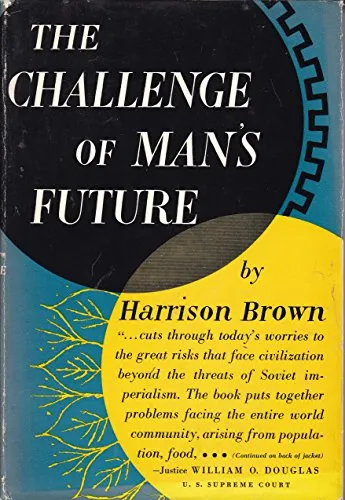
The problems and possibilities of man’s future on an earth he is constantly and increasingly draining of food, energy and vital materials and at the same time populating ever more numerously — these are arresting indeed. A young geochemist here takes up the challenge,- to survey the history of man on this planet, to show the results of his emergence, and to surmise possible turnings of man’s path. He balances statistics on population against our stock of resources and considers the “”what next”” of both.
[W]ithin a period of time which is very short compared with the total span of human history, supplies of fossil fuels will almost certainly be exhausted. This loss will make man completely dependent upon waterpower, atomic energy, and solar energy–including that made available by burning vegetation–for driving his machines. There are no fundamental physical laws which prevent such a transition, and it is quite possible that society will be able to make the change smoothly. But it is a transition that will happen only once during the lifetime of the human species. We are quickly approaching the point where, if machine civilization should, because of some catastrophe, stop functioning, it will probably never again come into existence.
It is clear that machine civilization as it is organized at the present time may revert to agrarian culture. In view of this possibility, the most probable pattern for the future of mankind is that sooner or later the entire world will become an agrarian one. This could come about in one of several ways. The status quo could be maintained with abortive attempts on the part of agrarian regions to industrialize, leading eventually to depletion of ore deposits, followed by the decline and eventual decay of machine culture. The regions of advanced machine culture might fight one another and so disrupt the elaborate machine network that recovery would be impossible. The greater part of the world might actually succeed in industrializing, but a catastrophe could bring about reversion to agrarian existence.

I have updated the Virtual Walk Maps and have corrected them to reflect the actual total distance. What I have shown for some of the individual four week distances have been erroneous but the total distance is now correct. I have not, and will not attempt to correct the individual four week distances.
Google Maps calculates different totals because it optimizes each route segment independently based on real-time conditions rather than summing fixed distances. What this means is I can not simply add the past four week distance to the prior total and get the same total distance that I get by having Google Maps give me the distance between the start to the current location. On top of that Google Maps can give me a different total distance for the start to the current location when I ask for it at different times.
There are alternatives to Google Maps but they may have similar issues. Using the same lat lan coordinates I get 1410 mi with Google Maps, 1411.6 with latlngdata.com & 1412.9 with infinitycalculator.com plus it is VERY difficult to find the lat lan coordinates that will give me the walking distance that I have recorded. So, any of those are probably ‘good enough’ as my Bulgarians would say. HA