
We have long since lost our faith in the idea that human beings could achieve human happiness in some future ideal state—a state that Thomas More, writing five centuries ago, tied to a topos , a fixed place, a land, an island, a sovereign state under a wise and benevolent ruler. But while we have lost our faith in utopias of all hues, the human aspiration that made this vision so compelling has not died. Instead it is re-emerging today as a vision focused not on the future but on the past, not on a future-to-be-created but on an abandoned and undead past that we could call retrotopia.
The emergence of retrotopia is interwoven with the deepening gulf between power and politics that is a defining feature of our contemporary liquid-modern world—the gulf between the ability to get things done and the capability of deciding what things need to be done, a capability once vested with the territorially sovereign state. This deepening gulf has rendered nation-states unable to deliver on their promises, giving rise to a widespread disenchantment with the idea that the future will improve the human condition and a mistrust in the ability of nation-states to make this happen. True to the utopian spirit, retrotopia derives its stimulus from the urge to rectify the failings of the present human condition—though now by resurrecting the failed and forgotten potentials of the past. Imagined aspects of the past, genuine or putative, serve as the main landmarks today in drawing the road-map to a better world. Having lost all faith in the idea of building an alternative society of the future, many turn instead to the grand ideas of the past, buried but not yet dead. Such is retrotopia, the contours of which are examined by Zygmunt Bauman in this sharp dissection of our contemporary romance with the past. — Book promo @ goodreads.com
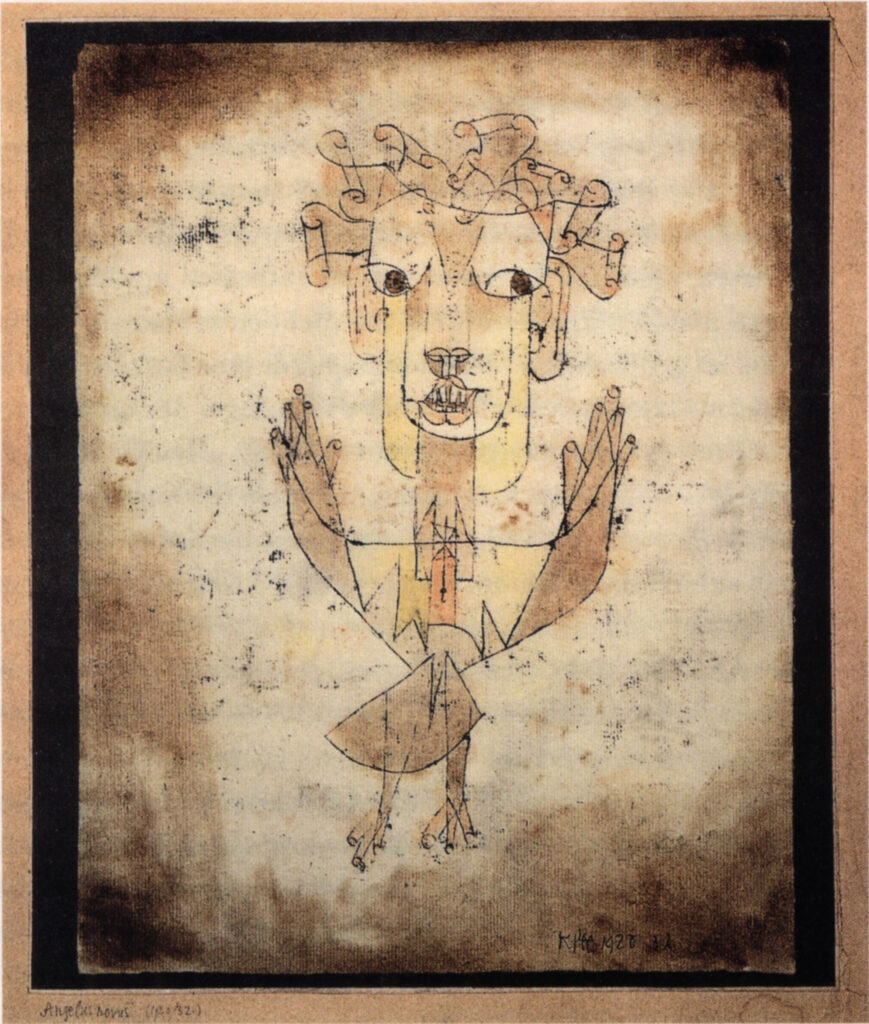
The Angelus Novus (renamed the ‘Angel of History’) – drawn by Paul Klee in 1920
The face of the angel of history is turned toward the past. Where we perceived a chain of events, he sees a single catastrophe which keeps piling wreckage and hurls it in front of his feet. The angel would like to stay, awaken the dead, and make whole what has been smashed. But a storm is blowing from Paradise; it has got caught in his wings with such violence that the angel can no longer close them. This storm irresistably propels him into the future to which his back is turned, while the pile of debris before him grows skyward. The storm is what we call progress.
In the case of acts of terrorism, their unfocused character and the randomness of their victims tend to be demonstrated and emphasized deliberately and explicitly, in a way impossible to overlook – with the intention to maximally expand the shocking impact of the terrorist act produced by a locally conceived and locally performed violence: the message conveyed by that randomness is that no one is safe; whether guilty or innocent, anybody – anytime and everywhere – could fall victim to future vengeful explosions of anger. Trying to prove to oneself and to others one’s own non-involvement in causing the avenged injustice will be to no avail, and neither here nor there. The message intended to be sent by the calculated randomness of the outrage is that all of us, with no exception, have similarly valid reasons to be afraid of the prospect of experiencing first-hand, and personally tasting, the horrors of the victims’ fate.
People do not necessarily vote in their self-interest’, George Lakoff warns: ‘They vote their identity. They vote their values. They vote for who they identify with.
They may identify with their self-interest. That can happen. It is not that people never care about their self-interest. But they vote their identity. And if their identity fits their self-interest, they will vote for that. It is important to understand that point’.
Otherwise, he adds, ‘facts go in and then they go right back out. They are not heard, or they are not accepted as facts, or they mystify us.
Why would anyone have said that? Then we label the fact as irrational,
crazy, or stupid’ – and by proxy we extend that label to those who said it, ‘in case they did not carry that label before speaking’.
Jim Jackson, Professor of Sustainable Development at the University of Surrey, managed to embrace all of these levels in a single concise phrase: ‘It’s a story about us, people, being persuaded to spend money we don’t have on things we don’t need to create impressions that won’t last on people we don’t care about.’