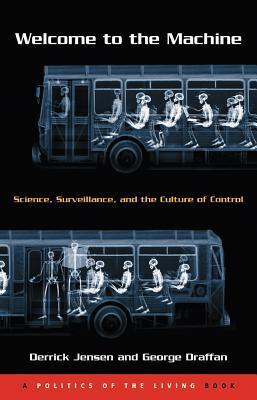
You could call them the Monkeywrench Gang of the nanotech age. Derrick Jensen and George Draffan are taking down the data mining industry, one converted mind at a time. In the face of RFID chips, consumer tracking strategies, and illegal government wiretapping, Jensen and Draffan are determined to show consumers how to fight back against government and industry to regain their rights, their privacy, and their humanity. In their new book, Welcome to the Machine, Jensen and Draffan take a hart-hitting look at the way technology is used as a machine, to control us and our environment. Their results are startling. If the prospect of perpetual surveillance and psychological warfare alarms you, you are not alone. Most people would be disturbed if you told them that everything from their store purchases to their public transit rides are recorded and filed for government or corporate access. But more often than not, the smooth, silent cleanliness of its operation allows the Machine of Western Civilization to go unnoticed. In Welcome to the Machine , Jensen and Draffan draw our attention back to its eerie, persistent white noise and take a cold, hard, human look at the cultural conditions that have led us to all but surrender to its hum. Jensen and Draffan, who teamed up in 2003 to expose industrial corruption and destruction in Strangely Like War: The Global Assault on Forests , are back to reveal both the terrifying extent of surveillance today and our chilling complacency at the loss of everything from consumer privacy to civil liberties. In this timely and important new collaboration, Jensen and Draffan take on all aspects of Control everything from the government’s policy of total information awareness to a disturbing new technology where soldiers can be given medication to prevent them from feeling fear. They write about pharmaceutical packaging that reports consumer information, which is then used to send targeted drug advertisements directly to your TV. — Book promo @ goodreads.com

The following quote is from The Hours That Shook West Asia by Pepe Escobar. I recommend the entire posting, Pepe is not one of your main stream ‘journalists’ he tells it like it is or at least as he sees it not as he is told to report it.
During indirect “negotiations” in Oman the Trump 2.0 team required Tehran to clarify an offer that required some final fine-tuning.
Oman’s Foreign Minister Badr bin Hamad al Busaidi confirmed that Iran, for the first time, agreed to “never” accumulate nuclear material for a bomb; maintain zero stockpiles of enriched material; agree that existing stockpiles would be down-blended; and allow full IAEA verification.
The meeting took place in Tehran on Saturday morning, uniting top members of the Iranian leadeship.
The Epstein Syndicate duly bombed the meeting, killing top officials plus Supreme Leader Ayatollah Khamenei. The Empire of Chaos does not do negotiations: it uses them as a weapon.
This is also a good article, End Deceptive Trumpian Diplomacy by Alastair Crooke. This is Trump’s The Art of the Deal as he plays it.
The build-up of U.S. forces was first imagined by Trump to be, of itself, sufficiently intimidating psychologically for Iran, that capitulation was pre-ordained. Witkoff said it plainly on Fox News: Trump was confused and frustrated as to why Iran had not already capitulated in face of such an American array of forces near to Iran.
But more than this, for Trump – who lives by grandiose statements and promises of ‘unbelievable American military prowess’ — he was disconcerted to see leaks revealing that, despite the force build-up, the U.S. does not have the military capacity“to sustain [beyond] a four to five day intense aerial assault on Iran – or a week of lower intensity strikes”. He later contradicted his Generals.
Trump’s Generals had provided him with a much more complex picture: They were not willing to guarantee regime change; there would be no certainty about the length of the campaign, and there would be no ability to accurately predict Tehran’s response – or the regional implications.
Likely, Trump, despite the warnings, imagined (or hoped for …) a short bloody war of a few days, after which he could claim ‘Victory’ over the extended debris, and then hope to manoeuvre towards a ceasefire — with media headlines shouting another ‘Trump Peace’.