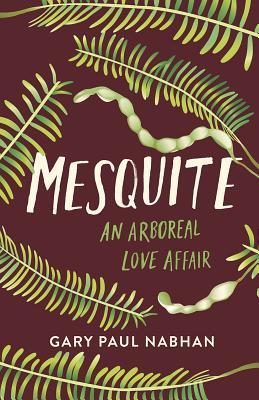
An unconventional ode to the wonders of mesquite.
Call it a love affair or an obsession: Award-winning nature writer and ethnobiologist Nabhan (Ethnobiology for the Future: Linking Cultural and Ecological Diversity, 2016, etc.) has a thing for mesquite. Early on he writes rapturously of his desire to become a tree, or at least to become more like a tree—and not just any tree. In his view, the mesquite is of singular importance as an icon, a framer of one’s worldview, a foodstuff, a beverage, a seasoning, a medicine, an antiseptic, a source of fiber and fuel, and a resource for architects and artisans. The author also argues that mesquite has feelings and intelligence, defending this thesis with down-to-earth stories about its remarkable abilities to heal itself, to engage with and offer nourishment and pleasure to its flora and fauna neighbors, and to shape its environment. Nabhan has clearly spent considerable time as an observer of mesquite, and he has a way with words, sometimes punning, sometimes waxing poetic, and never, it seems, holding back in his enthusiasm for his subject. He invites readers to pledge allegiance with him “to this flagship species of the United Desert States of America, and to the mycorrhizal mass on which it stands, one cohesive nation in all creation, its flora and fauna indivisible, with love fests and wild times for all.” Mixed into this odd, sometimes preachy, and often emotional mélange is plenty of solid information about mesquite, its history, and its utility. An activist in the local food movement, Nabhan concludes with 11 mesquite recipes, some quite labor intensive, and detailed instructions for harvesting and processing the pods. A charming yet quirky book that may puzzle readers outside the deserts of the American Southwest, who are accustomed only to supermarket bags of mesquite for their charcoal smokers. — Kirkus Reviews
It has been stated that in 1492 Cristóbal Colón began the ecological transformation of the Americas, a disastrous set of events, which some scholars call the Columbian Exchange, and which I affectionately refer to as the Great Colónoscopy of the Americas. In 1521, Criollo cattle and horses were taken off ships in the port of Veracruz, Mexico, presaging the later conquest of the Americas by White Castle burgers known as “sliders” and by horses’ asses in the US Congress.

We have been getting afternoon rain showers almost every day for the past week. The one Monday continued off and on during the night and into Tuesday morning. When we were to go out for our morning walk it was a very light mist. I decided that with the total cloud cover a walk was probably not a wise thing to do. Within 15 minutes it was raining again.
We did get to do our afternoon walk when the sun came out again. However, by the time we had arrived at the turn around point it was clouded up again. Had a few sprinkles during the final five minutes of the walk and then the rain came within minutes after we reached Desperado. There was a very had rain for a few minutes that had water running off the roof in a steady stream. That was good because I think when the water pools on the roof is when I get the leak and that did not happen yesterday.
Total cloud cover again this morning so I didn’t walk again, didn;t want to take the chance of getting soaked. Maybe clear like it did yesterday and we can do an afternoon walk?
Received an email from the Reserve garage asking if I was still in the area. Did not say that he had an engine. Nothing from the RV service shop about receiving the A/C unit.